How Interactive Counting Activities Build Early Numeracy Skills in Nursery
The early years of a child’s education play a vital role in shaping the way they think, observe, and understand the world around them. During this stage, learning is most effective when children are encouraged to explore concepts through meaningful, hands-on experiences rather than memorising facts or following instructions mechanically. This is especially true for mathematics, where understanding begins not with numbers on a page but with recognising quantities, identifying patterns, and making connections through everyday interactions.
Early numeracy is much more than learning to count. It helps children develop logical thinking, problem-solving abilities, observation skills, and the confidence to engage with mathematical concepts as they grow. Interactive activities that allow children to see, touch, count, and match objects make these abstract ideas easier to understand while nurturing curiosity and a genuine interest in learning.
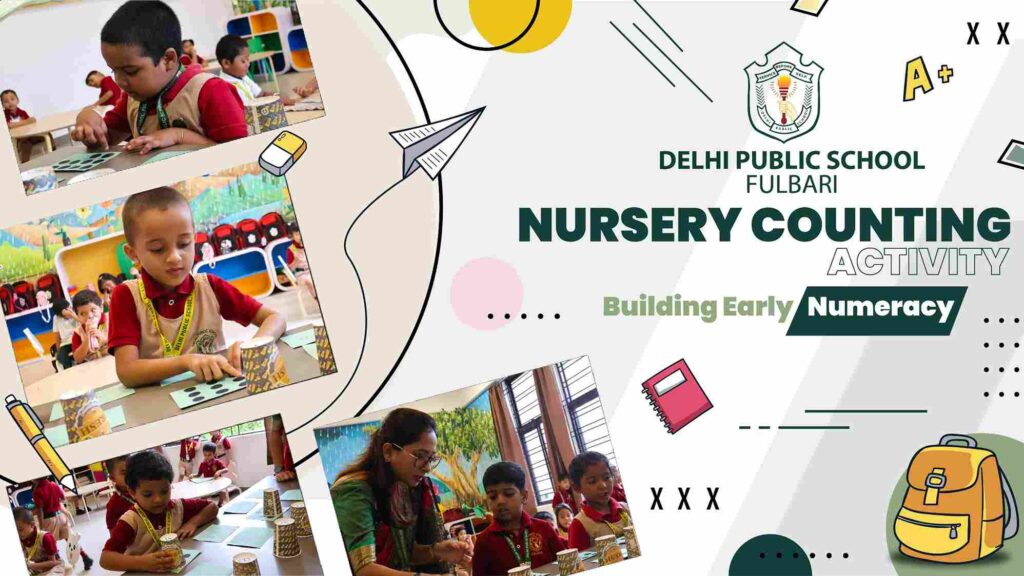
Keeping this child-centred approach at the heart of early years education, the Nursery students at DPS Fulbari recently participated in an engaging counting and number-matching activity. Designed to strengthen foundational numeracy skills in a joyful and interactive way, the classroom experience encouraged children to explore numbers through active participation, helping them build confidence while making learning both meaningful and enjoyable.
Why Are Interactive Counting Activities Important for Early Numeracy?
Early numeracy begins with helping children understand that numbers represent real quantities, not just symbols. Before learning addition or subtraction, children first develop these foundational concepts by counting objects, recognizing numerals, and matching quantities with numbers.
Interactive counting activities make this learning meaningful by allowing children to see, touch, count, and connect what they observe with the correct numeral. Rather than memorising numbers, they build a clear understanding of how numbers relate to everyday experiences. This hands-on approach also encourages careful observation, independent thinking, and active participation. As children experience success through enjoyable activities, they gradually become more confident in exploring mathematical concepts, creating a strong foundation for future learning.
How Did Nursery Children Learn Through This Counting Activity?
Objective of the Activity
The counting activity was designed to help nursery children strengthen their early numeracy skills through a simple, hands-on learning experience. By counting groups of dots and matching them with the correct numerals, the activity encouraged children to develop counting ability, recognise numbers, and participate independently. Most importantly, it introduced mathematical concepts in an engaging and enjoyable way, helping children build confidence while learning through active exploration.
How the Activity Was Conducted
The classroom came alive with curiosity as each child selected a worksheet displaying a group of dots. Instead of simply identifying a number, they carefully counted each dot one at a time before matching the total with the correct numeral displayed on the glass. This thoughtful process helped children understand that every numeral represents a specific quantity, strengthening the connection between numbers and real objects.
Throughout the activity, teachers gently guided and encouraged the children while allowing them to think independently and complete the matching on their own. Every successful match became a small achievement, motivating them to participate with enthusiasm and confidence. The interactive nature of the activity kept the learners engaged from start to finish, transforming a foundational mathematics lesson into an enjoyable classroom experience where exploration, observation, and learning naturally went hand in hand.
What Did Children Learn Beyond Counting?
Number Recognition
Matching the counted dots with the correct numeral helped children recognise that each symbol represents a specific number. Instead of memorising numerals in isolation, they learned to identify them by connecting what they counted with what they saw, making number recognition more meaningful and easier to remember.
Quantity Association
As children counted each dot before selecting the matching numeral, they began understanding that numbers represent actual quantities. This one-to-one correspondence is one of the earliest mathematical concepts, helping young learners build a clear connection between objects and the numbers used to represent them.
Observation & Concentration
Completing the matching activity required children to observe carefully, count without skipping, and stay focused until they found the correct numeral. These moments of attentive learning strengthened their concentration while encouraging them to approach each task with patience and accuracy.
Independent Thinking
Rather than relying on immediate answers, children were encouraged to count, compare, and make their own choices before matching the correct numeral. This simple decision-making process nurtured independent thinking and gave them the confidence to complete the activity with minimal guidance.
Confidence
Successfully completing the counting and matching task gave children a sense of achievement that encouraged them to participate with greater enthusiasm. Positive learning experiences like these help build confidence from an early age, making children more willing to explore new mathematical concepts as they grow.
How Do Small Learning Experiences Build Strong Foundations?
The strongest foundations are built through meaningful experiences that encourage children to explore, discover, and learn with confidence. During the early years, every thoughtfully planned classroom activity becomes an opportunity to strengthen essential skills while nurturing curiosity and a positive attitude towards learning.
At DPS Fulbari, learning extends beyond completing an activity; it is about helping children understand concepts through participation, exploration, and age-appropriate experiences. Activities like this counting and number-matching exercise are designed to make learning enjoyable while gradually building the confidence and skills children need as they progress through their academic journey.
By creating a supportive and engaging classroom environment, the school encourages every child to learn at their own pace, celebrate small achievements, and develop a lifelong enthusiasm for learning. It is these meaningful early experiences that help lay the foundation for confident, curious, and capable learners.
Every meaningful learning experience in the early years contributes to a child’s growing confidence, curiosity, and understanding of the world. Through thoughtfully designed classroom activities, DPS Fulbari continues to create opportunities where learning is not only effective but also joyful, inspiring young learners to take each new step with enthusiasm.
Links: